Thanksgiving slows many families down. Relatives gather, kitchens fill up, and the same stories get told around the table year after year. Those rituals are what turn a holiday into a tradition, and they also happen to be full of the language young children need as they get ready to read.
You don't need new books, workbooks, or learning toys to make the most of it. The Thanksgiving literacy activities below use what you already have: family stories, paper and crayons, the books on your shelf, and your local library.
At Reading in Preschool, our tutoring is built on the Alexander Reading Method, a play-based phonics curriculum. We believe children build strong foundations when stories, books, and conversation are a regular part of family life, not something saved for lesson time. The holiday season is an easy place to start.
Why Thanksgiving Traditions Support Early Literacy
Reading starts long before a child decodes a word. It grows from hearing lots of language, talking about it, and noticing that print carries meaning. A busy holiday gives children plenty of chances to practice all three, often without anyone calling it learning.
Here is where everyday Thanksgiving moments connect to early literacy skills:
Vocabulary: Cooking and family conversation bring in words children rarely hear, like baste, harvest, ancestor, or recipe.
Listening comprehension: Following a grandparent’s story, or a read-aloud after dinner, asks children to hold onto details and make sense of them.
Oral language: Answering questions at the table and describing their day gives children practice putting thoughts into words.
Narrative and sequencing skills: Retelling what happened first, next, and last is the same thinking children later use to understand stories they read.
Print awareness: Recipes, place cards, and grocery lists show children that the marks on a page have a purpose.
Early writing: A scribbled thank-you note or a few letters on a list is a real attempt to communicate in writing.
Comprehension foundations: Talking about why someone in a story felt a certain way builds the understanding children will need when they read on their own.
These overlap with the five essential early literacy skills every preschooler needs, including vocabulary, print awareness, and narrative skills. That post explains each one in more detail if you’d like to know what to watch for at home.
The goal isn’t to turn the holiday into a lesson. It’s to notice the literacy that is already happening and give it a little more room.
Not sure which early literacy skills your child needs most? Talk with our team about where your child is today.
Retell Family Stories Together
Thanksgiving brings together the people who hold your family's stories. That makes it a natural time for family storytelling activities with young children.
You might:
Share stories from your childhood
Talk about favorite Thanksgiving memories
Look through family photo albums together
Ask relatives to retell family traditions
Encourage your child to describe favorite holiday memories
When children listen to a story, they practice following a sequence and picking up new words in context. When they retell one, they practice organizing their thoughts and choosing words to share them. If your child’s version comes out jumbled, that’s normal. Repeat it back in order (“So first we drove to Aunt Lisa’s, then we ate pie”) and let them try again next time.
Start a Family Gratitude Jar
A gratitude jar is one of the simplest Thanksgiving writing activities for preschoolers, and it works for every age in the family.
What you need: A jar, bowl, or box, some scrap paper cut into slips, and crayons or pencils.
How it works:
Put the jar somewhere everyone passes each day, like the kitchen counter.
Each day in November, every family member adds one thing they’re thankful for.
On Thanksgiving, or at the end of the month, take the slips out and read them aloud together.
Everyone can take part at their own level:”. The list now includes kindergartners, so “young children” no longer fits.
The jar shows children why people write: to save an idea and share it with someone else. Reading the slips later also lets them see their own words turned into print.
Let Children See You Reading and Writing
Children notice what the adults around them do. When reading and writing show up in your everyday routine, children learn that print is useful, not just something for school.
You might:
Read recipes while cooking and point to the step you're on
Write grocery lists together and say each word slowly as you write it
Read labels and instructions
Write notes and cards, like place cards or a thank-you card
Share what you're reading
Talk through what you're doing as you go: "I'm reading the recipe to see how much flour we need." Those small comments help children connect reading and writing to real reasons for using them.
Place Books Around the House
You don't need a large collection. A few books spread around the house get picked up far more often than a full shelf in one room.
You might place books:
Near the couch
In the kitchen
Beside the bed
In the car
Near toys or play areas
Use the books you already own, or borrow a stack from the library. Familiar favorites are worth keeping within reach, too. Children often ask for the same story again and again, and each reread helps them notice new words, pictures, and details.
When books are easy to grab, children start exploring them on their own: turning pages, looking at pictures, and “reading” the story aloud from memory. That kind of independent play builds familiarity with how books work. For long holiday drives, a few books in the car pair well with some travel-friendly literacy games for road trips. They turn time in the car into easy, screen-free language practice.
Want expert guidance alongside your home reading? Explore one-on-one tutoring for ages 2.5 through second grade.
Play Audiobooks and Read-Aloud Stories
Listening to stories is one of the easiest ways to add more language to a busy holiday, and it costs nothing if you use free library apps or your own read-alouds.
They can be especially helpful:
Before bedtime as a way to wind down
During quiet time
While cooking together
During car rides to and from family gatherings
Listening helps children hear new vocabulary, longer sentences, and expressive voices they might not hear in everyday conversation.
You can make it even richer by pausing now and then:
“Why do you think the bear was sad?”
“What do you think will happen next?”
“Have you heard the word feast before? What do you think it means?”
If you’re reading aloud yourself, our interactive storytime ideas offer more ways to get your child involved, like acting out actions or chiming in on repeated lines. Those small moments of participation help young listeners stay engaged.
Visit Your Local Library Together
Libraries are one of the best free literacy resources for families. What each library offers varies, so check your local branch's website or ask at the desk.
Many libraries offer:
Picture books and seasonal stories
Audiobooks and ebooks, sometimes through free apps
Early literacy activities or play spaces
In-person story times for babies, toddlers, or preschoolers
Family literacy events
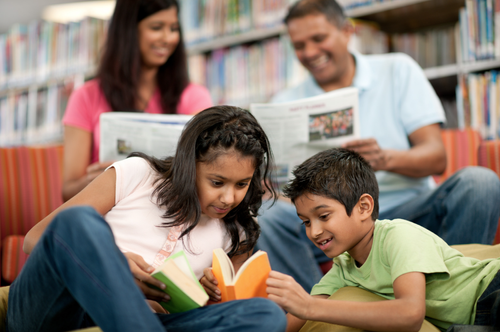
Let your child help choose the books. Children often feel more excited about a book they picked out themselves, even if it isn’t the one you would have chosen. Give a few guidelines (“Pick two books about animals and one about the fall”) and then let them decide.
A trip to the library the week of Thanksgiving, or once a month all year, is an easy family literacy tradition to keep. Many children start looking forward to it as a regular outing.
Ready to turn these family habits into stronger reading skills? Talk with our team about your child’s next step.
How to Keep Family Literacy Traditions Going After Thanksgiving
The habits that work over the holiday can carry into an ordinary week. A few ways to keep them going:
Read together most days. Short and regular beats long and rare. Ten or fifteen minutes before bed is plenty.
Talk about the day. At dinner or bath time, ask open questions like “What was the funniest thing that happened today?”
Welcome questions. When your child asks what a word means or why something happened, treat it as a chance to talk, not a detour.
Fold writing into chores. Let your child help with lists, label a box, or sign a card.
Follow their interests. A child who loves trucks, dinosaurs, or cooking will listen longer to stories about them.
Keep it light. If your child is tired or not interested, stop and try again another day. Literacy at home works best when it feels like time together, not a task.
Winter break is the next easy opportunity. Our list of holiday break activities that build letter and sound skills uses things you likely already have, like play dough, sidewalk chalk, and toy cars. They’re a playful way to keep practicing until school starts again.
Literacy Starts at the Thanksgiving Table
The stories, lists, recipes, and books that already fill your Thanksgiving are enough to support your child’s early literacy. You don’t need special materials or formal lessons. What helps most is your attention: asking questions, listening to the answers, and making room for books and writing in the middle of family life.
Home activities like these work alongside structured reading instruction, not in place of it. If you’d like extra support, Reading in Preschool offers one-on-one tutoring for children from age 2.5 through second grade, built on the Alexander Reading Method. Each child starts with an assessment, and lessons are tailored to where they are. You can explore our in-person and online reading tutoring to see how sessions work for each age group.
Frequently Asked Questions
Beyond the ideas above, try rhyming games while you cook (“What rhymes with pie?”), hunting for a letter on food boxes, singing songs with repeated lines, or playing I Spy with beginning sounds. All you need is conversation and things you already have.
You can start in infancy. Babies and toddlers benefit from hearing your voice, looking at pictures, and handling sturdy board books, even before they understand the story. Our PreK Reading Program supports children from age 2.5 once they’re ready for lessons.
There’s no fixed rule. Ten to fifteen minutes a day is a realistic goal for many families, and several short sessions work just as well as one longer one. Follow your child’s attention, and stop while it’s still enjoyable. For more short, playful ideas, try our holiday break activities that build letter and sound skills.
Telling and hearing stories teaches children how a story is built, with a beginning, a middle, and an end. Knowing that structure helps them follow and understand books when they start reading on their own. Our guide to the five essential early literacy skills every preschooler needs explains how storytelling fits in.
That’s common with toddlers and young preschoolers. Try shorter books, let them hold the book or turn the pages, or read while they play nearby. Listening still counts, even when they’re moving. For more ways to keep them engaged, try our interactive storytime ideas.
Want More Support With Reading at Home?
If your child is ready for more, our PreK Reading Program builds early reading skills through play-based lessons with an Alexander Reading Method Specialist. We teach in person in New York, Connecticut, Florida, and Los Angeles, and online worldwide. For more at-home practice, browse The Alexander Reading Method store.
Ready to help your child feel confident with reading?
Talk with our team about how the Alexander Reading Method fits your child's level.